October 21, 2026
How to Follow Up With First-Time Church Visitors
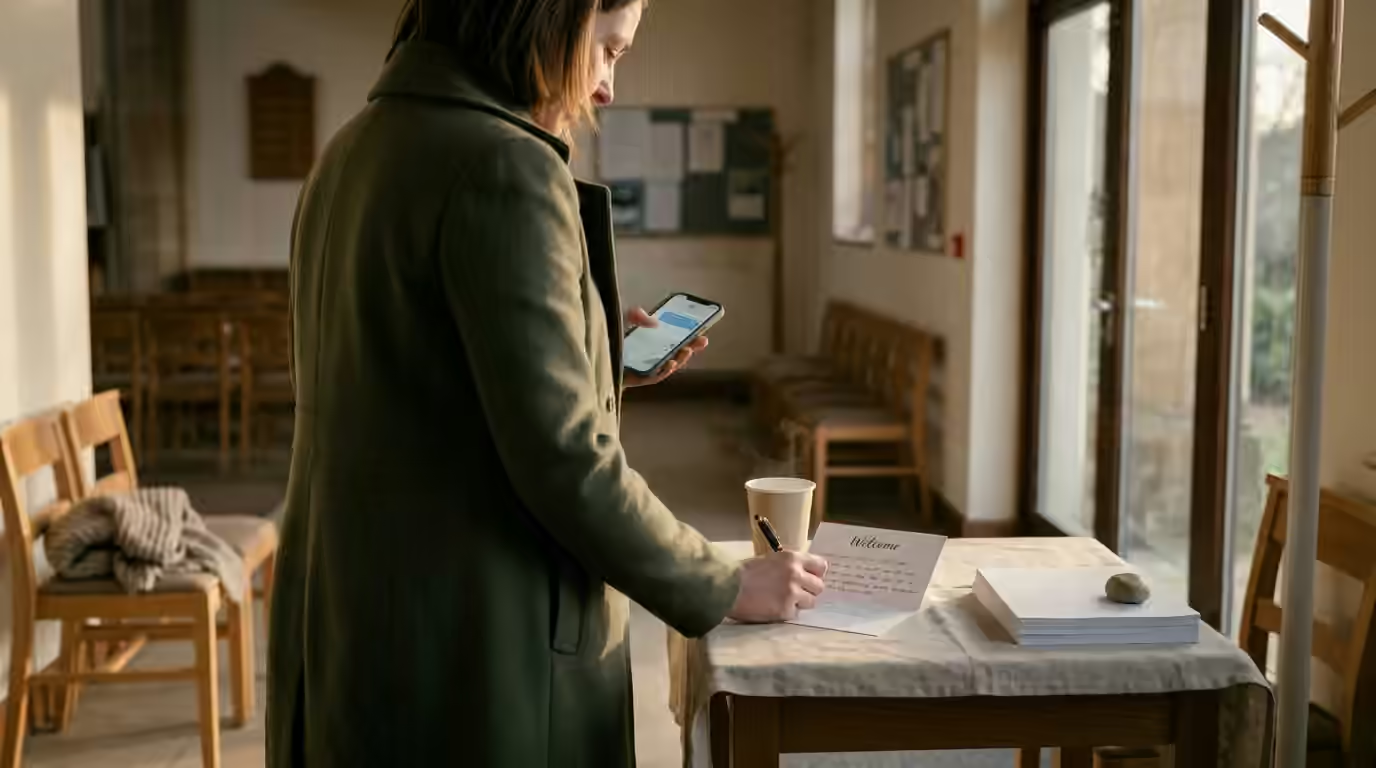
In our faith, care for the stranger is not an extra. The Greek word for it is philoxenia, love of strangers, and Hebrews 13:2 reminds us that some have welcomed angels without realising it. Church visitor follow up is what that love looks like on a Monday morning, once the guest has gone home and nobody can see whether you remembered them.
A lawyer once asked Jesus who his neighbour was. Jesus told him about a Samaritan who found a beaten man on the road. Then Jesus asked which of the three men on that road had been a neighbour to him. The answer was the one who showed him mercy (Luke 10:37). The Samaritan did not only lift the man onto his own animal. He took him to an inn, stayed the night with him, and paid the innkeeper to keep caring for him after he left.
That was mercy owed to a stranger on a road. How much more is owed to a brother or sister who walks into our building and decides to stay?
The question from the pulpit is a good start
Many pastors ask at the end of the service whether anyone is here for the first time, and invite them to stand and say their name. It is a good thing to do. The whole room turns and smiles, and the visitor is seen.
It stops working at a certain size. Two people stand one week, five the next, and by Thursday nobody can name them. A growing church cannot run its care on memory, and that is not a failure of love. I wrote more about that in why you can’t rely on memory in a growing church.
Tell visitors why you are asking for their details
Most churches put a form at the door, or hand one along the pew. It asks for a name, a phone number and an email address.
You and I know what that form is for. The visitor does not. They do not know where the paper goes tonight, who will read it, or whether anyone will use it at all. Handing over your phone number to a room full of strangers is a small act of trust, and we rarely explain what we are asking for.
So say it on the form, in one line. Tell them you would like to contact them this week, that you want to invite them to the other things the church does, and who will hold their details. Point them to a privacy notice in plain words. A visitor who knows why you are asking will usually tell you.
What church visitor follow up looks like in the first week
Reach them before the next Sunday. By then they have already decided something about you. Either this is a church where people noticed them, or it is a church where they could come and go unseen.
Write to them yourself, or ask the one leader who spoke to them to write. You can mention the hymn they sang, the fact that they came with their mother, or that you were glad they stayed for coffee. Say your own name. Tell them who to reply to.
A formal message says the church has a process. A short personal message says a person was watching, and was glad.
Invite them to the smaller gathering
Nothing feels worse than being new in a church, and then realising after two or three weeks that everyone around you is talking about a Bible study or a picnic you knew nothing about. Everyone else was invited. There was no notice to read, nobody to ask, and no way to sign up.
I do not think any church intends this. It simply happens. And it teaches the visitor something false about whether they belong.
So invite them by name to one smaller gathering. The Sunday service is where a person meets the church. A Bible study, a shared meal or a prayer evening is where they meet the people.
Nobody is responsible, so nobody calls
Five leaders see the new family. Each one assumes another has already written to them. Nobody writes. Everyone remembers it as a week when the church was welcoming.
We decide on the visitor’s behalf that they probably do not want to come to the youth evening or the women’s breakfast. But a person who has come three Sundays in a row has already shown you their intention. Ask them. Say you would be glad to see them on Wednesday. They cannot ask you, because they do not yet know who leads the Bible study or where the youth group meets.
Choose one leader for each new person, and let that leader own the follow-up until the visitor is settled.
When someone signs up and then does not come
Sign-ups tell you more than attendance does. Somebody who puts their name down for a camp six weeks away has told you they expect to still be part of this church in six weeks. They are planning their life around this church.
A no-show is worth noticing. Usually the reason is practical. The event was at a different building and they did not have the address. They arrived, found no sign saying which floor or which room, and went home rather than open three wrong doors. Everyone who has been in the church five years knows where to go. The newcomer needs to be told.
So look at the list afterwards and find the people who signed up and did not arrive. Each one is worth a friendly message that week, asking whether the place was easy to find rather than why they did not come.
Paper and group chats both lose people
Paper forms get lost. One sits in a drawer for a month. Another goes home in somebody’s bag. Somebody leaves one on a train.
Group chats fail differently. Messages scroll away, and a visitor’s phone number ends up in the personal phones of leaders. When one of those leaders leaves the church, the church has no way to remove what stays on their device. Under the GDPR, personal data revealing religious belief is a special category under Article 9, and a list of who attends your church reveals exactly that. If a member later asks for a copy of everything you hold and asks you to erase it, a right set out in Article 17, you cannot do that across six group chats and a drawer. This is general information rather than legal advice, and your own country may add rules on top.
The practical fix is to keep member details in one place the church controls, and give each volunteer only the people their role covers. I set that out in more detail in trusting volunteers with member data.
Where Velyora helps
I built Velyora after watching people drift out of a church quietly while everyone assumed someone else had noticed.
Visitors scan a QR code with their phone camera. There is nothing to install. They fill in a short form the first time, with your privacy notice in their own language, and after that each visit is one tap. Their names and contact details are encrypted on their own device, so your church can read them and I cannot.
Your dashboard shows who is new this week. You can mark someone as a visitor and record who introduced them. You can give each leader access to exactly the people and gatherings they look after, and leave shared notes for them on the church calendar. Members can sign up in advance for a picnic, a camp or a conference using the same QR code, and afterwards the list shows you who signed up and did not arrive. On the paid plans, Velyora tells you when a regular member has stopped coming, which lets you keep caring for new members even months after they join.
If you already run church management software, Velyora is small enough to sit alongside what you already use without moving any data.
Questions pastors ask about visitor follow-up
How soon should we contact a first-time visitor?
Within the first week, before they come back or decide not to. A short message on Monday or Tuesday does more than a careful letter the following Saturday.
What should the first message say?
Give your name, mention something you remember about them, and invite them to one thing with a day, a time and an address. Keep it to a few lines.
Is it too much to ask for a phone number on their first Sunday?
Not if you say why. Ask for the least you need, explain what you will use it for, and let them leave it blank. Collecting it at check-in instead of on a paper slip also means it is not lying on a table all morning. Here’s how to track church attendance without a clipboard.
Someone signed up for our retreat and never came. What do we say?
Ask, and assume a practical reason first. Something like: we were expecting you on Saturday and missed you, was everything all right? Often the answer is that they could not find the place.
Looking after the people God sends you is your first work, and most of it is noticing in time. If you want help noticing when one of them stops coming, you can start with Velyora and have three months of the premium features free, with no card. God bless you and your church.