October 10, 2026
How to track church attendance without a clipboard
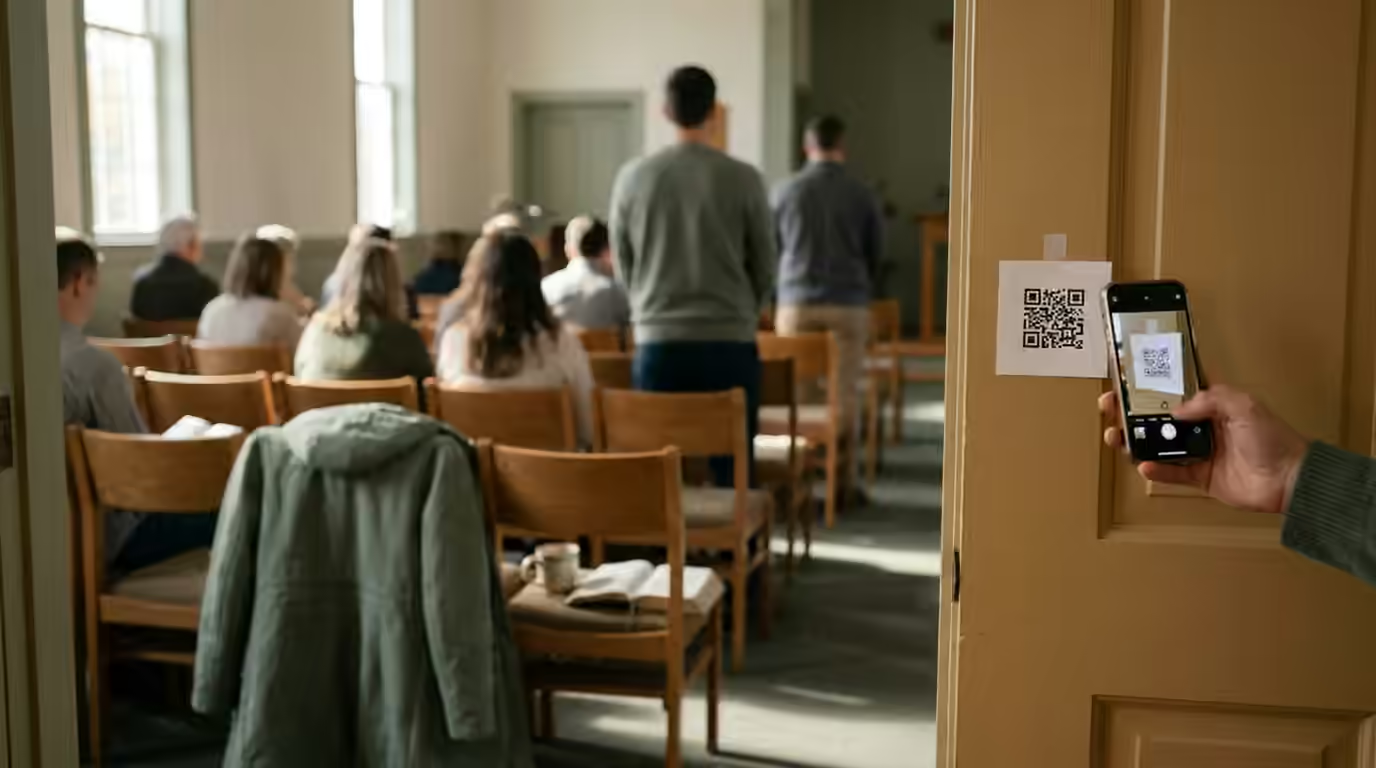
Every member of your church matters, and each one is carrying burdens you cannot see from outside. Some weeks the pressure is heavy enough that a person cannot get out of bed on a Sunday morning. That is the moment they need their church most, and it is also the moment they go quiet. Tracking church attendance is not about counting numbers. It is about knowing that someone is absent, early enough to pick up the phone.
Why is an absence noticed sooner in a village than in a city?
In a small village, the church would notice an absence very early. People would even notice during the week, because someone’s curtains stayed shut. In cities that is much harder. We live further apart, and much of our friendship now happens through a screen with people who are not in our town at all. Our minds were never built to hold hundreds of names and remember which one we last saw in August. So a member stops coming and nobody notices it. I have written more about that limit in why you cannot rely on memory in a growing church.
Noticing an absence early gives a pastor a window. A phone call. A message. A visit that says, I saw you were not there, and I wanted to know how you are. Leaders can carry part of this too, by watching over the people in their own group and simply being the friend who catches up. All of that depends on being told. And being told depends on having a record of who came.
Is counting your church members even right?
This question deserves an honest answer, because it stops some pastors before they start.
Keeping a list is not David counting Israel. What went wrong there was the heart behind it, a king measuring his own strength. If you are counting because you want your numbers to climb, or because you want to lean on the size of your congregation, Scripture already answers you. God sees that.
If you are counting because you want to know who is missing, that is a different thing entirely. “Be sure you know the state of your flocks, and put your heart into caring for your herds” (Proverbs 27:23). The shepherd in Luke 15 knew he had ninety-nine because he knew he had lost one.
Three ways to track church attendance
Assume the intention is right. To take care of your missing church members. You still need a method to track your church members’ attendance. There are three methods, and each one costs you something.
1. A list someone ticks at the door
A sheet of paper, or an Excel file on a laptop. A member writes their name the first time they attend the church service, and afterwards, someone ticks their name every week. It works. It also needs a person at the door who knows every face, or who asks for a name and then hunts for it in a list. On a busy Sunday that becomes a queue at the entrance while the service is starting. Paper has a second problem. It records your members’ religious affiliation, and it can be lost! A leader takes the sheet home because the pastor’s office was locked, and leaves it on a bench at the train station.
2. A card or printed code each member carries
Every member gets a card or a printed QR code when they join. Your welcome team scans it at the door and a church software that you use records the attendance, then the software tells you when someone has been missing. This is quick at the door, but it moves the work elsewhere. Plastic cards cost money, printed QR codes cost less, but your church members must remember to carry them. Your welcome team has to be trained, has to scan every single person, and has to not miss anyone while they are also welcoming them.
3. One QR code on the wall that members scan themselves
You put up a single QR code. Members point their phone camera at it on the way in. By the end of the service you know who came and who did not. This is the lightest option for your team, and the one that asks something of your members. Two objections come up. The first is apps. If the member has to install some app on his phone, for your church, most will refuse to do so. The second problem is trust in scanning QR codes. Most people are comfortable scanning them now, 58% say they grew more comfortable since March 2020, but 36% still worry about whether a code is secure, and older members are the ones most likely to struggle. YouGov found 14% of adults find QR codes hard to use, rising to 20% of over-65s.
That same research explains the solution. People are more likely to scan a QR code, when they can see what they are scanning. If the software allows you to put your church logo on the page, it becomes obvious the details are going to the church and not to some stranger agency. If it allows them to send a prayer request while they are scanning the QR code, or if it shows a welcome message from you, or a verse for the week, the moment they have checked in, that would be even better. Then you can also keep a tablet at the door with a special kiosk page open for anyone whose phone is not ready.
What happens when churches give up
Many churches try one of the 3 methods above, find it awkward, and quietly stop. The result is a church that feels like it is growing. New faces arrive most weeks and everyone is glad. But the overall size never changes, because as fast as people come in, others slip out. Nobody can tell you who has stopped coming, or when, or why. And who knows why? Was it the enemy whispering in their ear every Sunday morning: you are worthless, nobody cares about you, why are you going to that church? If you stop going, nobody will even notice. We do not know what happens to them. They just stop coming. And if you have no way to keep track of attendance, you cannot know.
Data breach: The part nobody plans for
All three methods share one risk. What happens if the system holding the data is broken into?
A breach of a church list is not like a breach of a shop’s mailing list. It exposes religious affiliation. It exposes who came with whom. Picture a courting couple who attended the church service together for a year, then parted ways, and years later, each of them married another person. A stolen attendance list puts that private information on the internet. I have written about more of these risks in what happens to your members when a church database is hacked.
Paper is not the safe alternative. Paper can be lost. It can be left on the train. And if your church is in Europe you have GDPR duties for this data. I am not a lawyer and this is not legal advice, so check your own obligations in the region of your ministry.
How Velyora handles all three
I built Velyora to solve the problem of tracking church member attendance, and it gives you all three methods at once in a secure and confidential way.
You can tap names on a list yourself. You can hand church members a printed QR code to show to the welcome team to scan. You can put one QR code on the door and on the projector for every church member to scan it themselves. Use whichever suits the person in front of you on the day.
Nobody installs any app for this. Your members use the phone camera they already have, and a web page opens in their phone. No downloads, no permissions, no new icon on a crowded phone. They fill in a short form the first time. If they let their phone remember them, every visit after that is one tap only.
Their names, contacts and prayer requests are locked before they ever reach us, so even we cannot read them. If our servers were stolen tomorrow, there would be nothing readable in them about your members. Only you and the helpers you choose can open those details, and you decide the level of access a helper has, whether he can see everyone or only members of specific gatherings.
If you already run church management software, you don’t need to replace it. Velyora works alongside what you already use and takes care of private check-in and the alert when someone stops coming. Prayer requests, pastoral care notes, attendance records, whenever you need to store information of your church members so confidential that even we cannot read it, use Velyora for free.
Questions pastors ask
Do our members need to install an app?
No. They use the phone camera and the browser that are already there. The first visit takes a moment to fill the form. After that it is just one tap.
What about members without a smartphone?
Keep a tablet or laptop at the door with the kiosk page open. Anyone can type their name and check in, and your welcome team can do it for them. Your welcome team members can also find their names from a list of existing members, and check them in. If you have printed individual member QR codes, church members can simply show it to your welcome team members to scan instead.
Will this feel like surveillance to our congregation?
It depends on what they see. A hand asking for a name at the door feels like a checkpoint. A code that greets them by their church’s name, shows a verse, and offers to pass a prayer request to the pastor feels like being welcomed. Tell them plainly why you are doing it.
Is the QR code really free?
Yes. Check-in and your QR code stay free. Paid plans are for keeping attendance history, alerts when a familiar face has been missing, and helper accounts.
How soon will I know someone has stopped coming?
As soon as the pattern breaks. Instead of realising in November that you have not seen someone since August, you see it the week it starts, while a phone call still feels natural.
One quiet absence is enough reason
Want to notice when someone stops coming? Get your church’s free QR code and start your three months free premium account. Take care of your flock. You never know when someone quietly stops coming.