September 30, 2026
Arriving Later Every Week: What Church Members Arriving Late Quietly Say
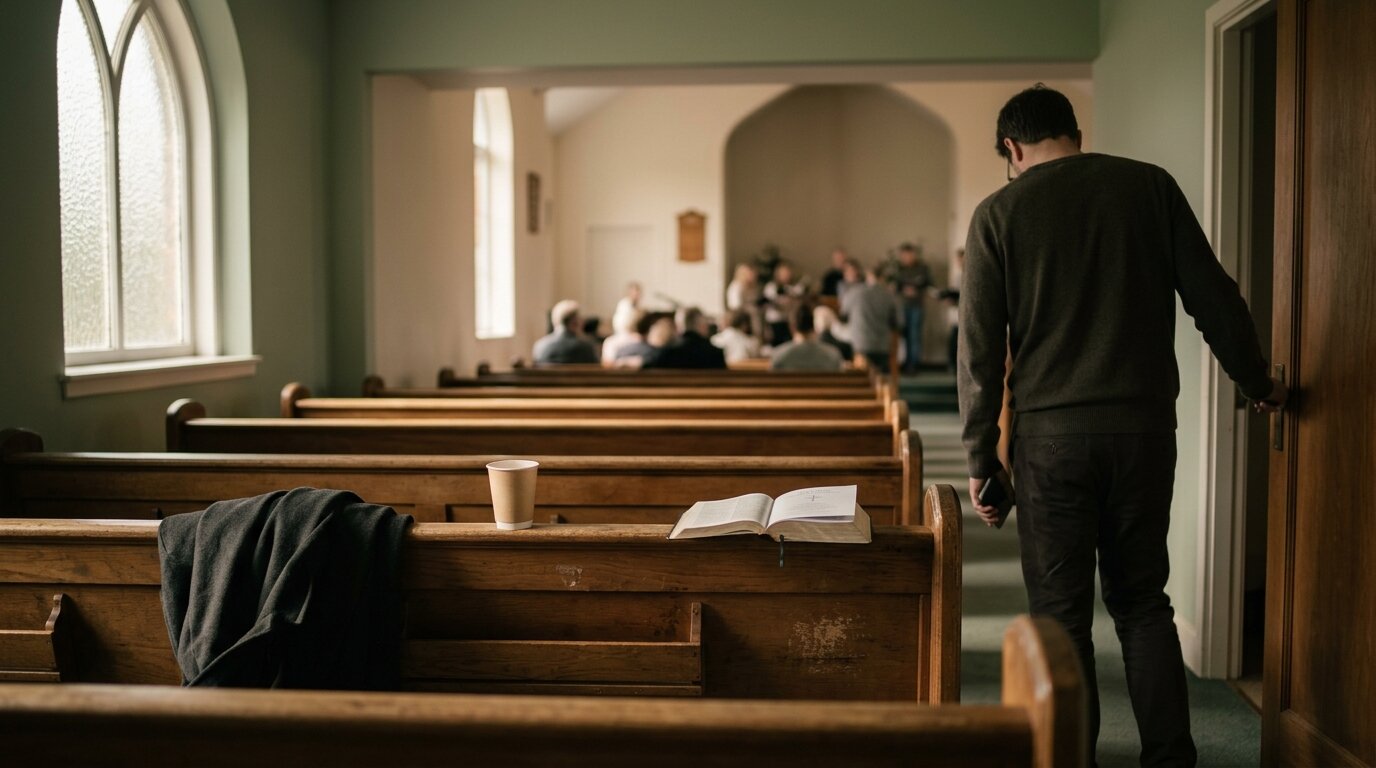
Most pastors can name the people who have stopped coming. Far fewer can name the people who are still coming, but are arriving later and later every week. And yet, in my experience, that second list is the more urgent one. Church members arriving late are still in the room. They are still reachable. The door has not closed. Something inside them has begun to shift, and lateness is often the first place it shows.
I want to be careful here, because this is a subject that gets handled badly. Lateness is easy to turn into a complaint, and a complaint is exactly the wrong response. So let me start not with the behaviour, but with what church is supposed to be.
We arrive early for what we long for
Jesus said, “Come to me, all you who labor and are heavily burdened, and I will give you rest” (Matthew 11:28). That verse tells us what a gathering of believers is for. People do not come to church to pay homage to a demanding God who wants their works. They come to rest. They come to be washed and fed and set back on their feet by living water.
And if church is where you rest, then tiredness is not a reason to stay away. It is a reason to come. “I am too worn out for church this Sunday” is a sentence that only makes sense if church has quietly stopped being a place of rest and started being one more obligation on a tired person’s list.
That is why arrival time is such a revealing thing. We arrive early for what we look forward to and for what we know we need. When a member used to be there twenty minutes before the start, chatting in the doorway, and now slips in during the last song, the timetable is not what changed first. Something changed inside, and the habit followed.
Lateness comes before absence
This is not only a spiritual intuition. It is one of the more settled findings in the research on how people withdraw from groups they belong to.
Organisational psychologists have spent decades studying what they call the progression of withdrawal. The basic claim is simple: people rarely leave in one step. Lateness is usually treated as the milder, earlier stage of a sequence that can continue until a person actually leaves, with the underlying attitude gradually expressing itself in more serious forms. Longitudinal studies of attendance records found exactly that pattern: a progression from lateness to absence, and from repeated absence to leaving altogether, with early lateness also making further lateness more likely. A later meta-analysis pulling these studies together concluded that the progression model had the most support, which means lateness can function as an early warning sign of the absence that follows.
A church is not a workplace, and I do not want to press the comparison too far. But the human being is the same human being. Belonging loosens before it breaks, and the loosening is visible in small things long before it is visible in an empty seat.
So when a member starts drifting from early, to punctual, to five minutes late, to twenty, the lateness is the tip of the iceberg. All of us have busy weeks. All of us have the night that went wrong and the Sunday morning that fell apart. That is not what I am describing. I am describing a direction of travel, sustained over months, when someone’s first love has cooled and their calendar is the last thing to find out.
Assume the innocent explanation first
Before you conclude anything spiritual from a pattern of delays, First try ordinary explanations:
A new job is the most common. Hospitality and service work in particular demands weekends, because that is precisely when customers have free time to visit. A member who now finishes a restaurant shift at two in the morning on Sunday is not a man whose faith has weakened. His circumstances have changed, and he is still coming, which may be costing him more than the early arrival ever did.
A new baby rearranges every hour of a household. A house move can turn a ten-minute walk into a bus with one connection. A parent’s illness, a car that failed its inspection, a child who now has to be collected from somewhere else first: none of these have anything to do with anyone’s love for God.
There is also the plain fact that some people simply run late by temperament. Research on punctuality points to a mix of psychological tendencies and time-estimation habits that nudge some people toward promptness and others toward delay, often without their realising it. People who consistently underestimate how long tasks take leave too little margin for real delays, which translates into late arrivals. That can mean, some of your most faithful members have been ten minutes late since the day they were born!
Never shame a latecomer
Here is the distinction I would ask every leader to hold onto. The person who comes late is not coming late to our ministry. They are coming late to the place where they are meant to be served.
In a company, an employee arrives to serve the company, so a manager who sees repeated lateness feels under-served and approaches with a complaint. In the kingdom of God everything runs the other way. “Whoever desires to become great among you shall be your servant,” Jesus said, “even as the Son of Man came not to be served, but to serve” (Matthew 20:26, 28). The pastor and the leaders are there to serve the people. So when someone arrives late, the loss is not that we received less service, it is that they received less ministry and we had less opportunity to give it.
That single reframing changes the whole conversation. You are not calling to correct. You are calling because somebody is receiving less than they need, and you would like to know why.
And remember: a person who is arriving late is very often already under strain. Whatever you say should not land as one more burden on a burdened week. If the reason is a punishing work schedule, you can pray about it and perhaps plan around it. If it is a faith growing cold, or if it is sadness, you can pray about that too, without making it an accusation. If the need is practical or financial, that is what a congregation is for.
The same instinct applies at every age, including the teenagers who quietly stop showing up, where the temptation to treat withdrawal as misbehaviour is even stronger.
Can you actually see it?
Which brings me to the hard part, and the reason I built what I built.
Be honest about what one person can hold in their head. Even with twenty or thirty people, can you say with confidence who arrived earlier last spring than they do now? Who has gone from twenty minutes early to exactly on the hour? Who has climbed back up from half an hour late to almost punctual, which is a quiet answered prayer worth naming? Can you see the trend, and can you see it while it is still a trend rather than an empty chair?
Think of how relationships scale. In a marriage, if your spouse comes to the dinner table later and later each night, you notice within a few nights. Among siblings it takes longer. At a gathering of relatives at Christmas it is harder still. In a church, where people arrived as strangers and are slowly becoming a family, one person can drift for the better part of a year before anyone notices. By the time we finally telephone, they might have settled their opinion about the whole of Christianity, and the opportunity we had to intervene was available to us six months earlier.
This is why Velyora exists. It is a check-in page for your church, opened with a QR code by the door. There is nothing to install, for you or for your members. Each check-in is recorded as early, on time or late, so the drift that no human memory can hold becomes something you can look at over months, alongside plain alerts when a familiar face has stopped coming. Your members’ names, contacts and prayer requests are locked on their own device before they reach us, so even we cannot read them: the record is for you and for the helpers you choose, and for no one else.
The point of the record is never the record. It is the phone call in the right week, the food given in due season (Matthew 24:45), the ninety-nine left in the wilderness for the sake of the one (Luke 15:4).
Questions pastors ask about lateness
Is lateness really a spiritual signal, or am I reading too much into it?
Often you are reading too much into it, which is why you talk with the member, before you conclude. What carries meaning is not one late Sunday but a sustained direction over months, especially in someone who used to arrive early. Treat it as a question, never as a verdict.
How should I open the conversation?
Warmly, privately, and without mentioning the clock as a problem. “I have missed catching up with you before the service, how are things?” is enough. Let them tell you about the new shift pattern or the new baby, and let the silence do some work if they do not. Some times just a few questions about “How was your week?” or “How is your school going?” would reveal the actual root cause, without you even mention the problem.
What if the reason is a job they cannot change?
Then bless it. Adjust what you can, whether that is a midweek call, a second gathering or simply making sure nobody makes a remark when they come in halfway through. Many people arriving late are being more faithful than the people already seated. At least he is still coming.
Should I announce anything about punctuality from the front?
I would not. A general appeal punishes the strained and rarely reaches the drifting, and it turns a pastoral matter into a public one. Speak to individuals, quietly. Try to find the root cause before even talking about the delay problem. After all, your intention is to pray and ask the Lord for help. For that, all you need is to know what’s wrong and what’s to pray about.
What about someone whose lateness is improving?
Notice that too. In our dashboard you can see that. And if you see one, say so warmly without making it about the timing. Someone climbing back from thirty minutes late to almost on time is telling you something is being healed. That is worth a word of encouragement and a prayer of thanks.
If you would like to see this pattern in your own congregation while it is still a pattern and not an absence, you can start free with Velyora and have a check-in QR code by your door this Sunday.